Minimum target age of child | Vaccine |
|---|---|
At birth | BCG |
*OPV0 | |
**HepB0 birth | |
6 weeks | Pentavalent (DPT, HepB and Hib) 1 |
Pneumococcal Conjugate Vaccine 1 | |
*OPV1 | |
***Rota 1 | |
IPV1 | |
10 weeks | Pentavalent (DPT, HepB and Hib) 2 |
Pneumococcal Conjugate Vaccine 2 | |
*OPV2 | |
***Rota 2 | |
14 weeks | Pentavalent (DPT, HepB and Hib) 3 |
Pneumococcal Conjugate Vaccine 3 | |
*OPV3 | |
***Rota 3 | |
IPV2 | |
6 months | Vitamin A 1st dose |
9 months | Measles 1st dose |
Yellow Fever | |
Meningitis Vaccine | |
12 months | Vitamin A 2nd dose |
Measles 2nd dose (MCV2) | |
9–13 years | ***HPV (6 months interval, 2 doses) |
Source: UNICEF 2023. | |
2 Background
2.1 Vaccination Coverage and the Health Sector in Nigeria and Kano State
According to the Nigeria Demographic and Health Survey (NDHS) 2023–24 report, the under-five mortality rate stands at 110 deaths per 1,000 live births (FMoHSW, NPC, and ICF 2024). In contrast, the global under-five mortality rate as reported by United Nations International Children’s Emergency Fund (UNICEF) in 2023 is 37 per 1,000 (UNICEF 2025).
Nigeria’s under-five and infant mortality rates stand well above global values, but the country has also shown improvements over the last decades. For instance, the infant mortality rate fell from 87 to 63 deaths per 1,000 live births between 1990 and 2023–2024 (FMoHSW, NPC, and ICF 2024).
Improved access to immunization is a principal driver of the decrease in under-five mortality in developing countries (Vaccine Impact Modelling Consortium 2021). In Nigeria, three decades of routine immunization programs have contributed to dramatic declines in vaccine-preventable diseases such as measles (Gavi 2023). The importance of vaccination in reducing child mortality cannot be understated: the Global Burden of Disease study (2019), for instance, estimates that 41% of under-five deaths in Nigeria may be vaccine-preventable, including deaths due to diarrheal diseases, lower respiratory infections, and meningitis (IHME 2023).
TipDefining the Zero-Dose Child
There are different approaches to defining the zero-dose status of a child (Wonodi and Farrenkopf 2023).
Conceptually, the term “zero-dose” should refer to those children who have not received any routine vaccinations (Wonodi and Farrenkopf 2023). However, for operational purposes, zero-dose children are defined by Gavi as infants who have not received the first dose of a diphtheria-tetanus-pertussis-containing vaccine (Diphtheria-Pertussis-Tetanus (DPT)) by 12 months of age (“penta-zero dose”) (Wonodi and Farrenkopf 2023; Gavi 2025).
In contrast, “unimmunized” children may have received some vaccines but not enough to complete the full immunization series—most often referring to those who have not received the third dose of DPT (DPT-3) (Gavi 2025).
This report will adopt Gavi’s definition for zero-dose children, unless otherwise specified.
Global progress in reducing the burden of zero-dose children depends on improving vaccination uptake in Nigeria, which has the largest number of zero-dose children worldwide (IHME 2024). In 2022, Nigeria accounted for an estimated 2.32 million zero-dose children, representing 14.5% of the global total of 15.98 million. This places it ahead of other high-burden countries such as India (1.92 million) and Ethiopia (1.25 million) in terms of absolute zero-dose burden (IHME 2024).
In Nigeria, routine immunization services are delivered primarily through the network of Primary Health Center (PHC) facilities, supported by outreach sessions in underserved areas. The program is led by the National Primary Health Care Development Agency (NPHCDA), with support from global and national partners including UNICEF, World Health Organization (WHO), Gavi, and Gates Foundation (GF). Yet, challenges such as vaccine stockouts, health worker shortages, and community hesitancy contribute to suboptimal coverage and the ongoing burden of zero-dose children.
There are also wide variations in immunization coverage by region, with the North having higher levels of zero-dose children and lower immunization coverage compared to the South, despite concerted efforts to equalize coverage levels across the country. In fact, Nigeria has some of the highest levels of geographic inequity for immunization coverage globally (Sato 2023; Wagai et al. 2021; C. Edson Utazi et al. 2023; WHO and UNICEF 2022; Dimitrova et al. 2023), as confirmed by several geospatial analyses (Sbarra et al. 2021; C. E. Utazi et al. 2019, 2018).
Within the North, Kano State consistently has one of the highest numbers of zero-dose children, particularly among those aged 12–23 months. According to estimates from the Institute for Health Metrics and Evaluation (IHME), approximately 294,200 children in this age group in Kano had received zero doses of a DPT-containing vaccine in 2022—equivalent to 12.7% of Nigeria’s total zero-dose burden (IHME 2024).
According to the NDHS, the estimated prevalence of truly-zero-dose children in Kano State rose from 8.8% in 2018 to 35.5% in 2023–24 (FMoHSW, NPC, and ICF 2024; NPC and ICF 2019). However, the proportion of penta-zero-dose children increased only slightly during the same period, from 40.2% to 42.4%. This discrepancy suggests that the low zero-dose estimate in 2018 may have been driven by widespread receipt of Oral Polio Vaccine (OPV) alone. In 2018, coverage for OPV-1, OPV-2, and OPV-3 in Kano was relatively high at 85.5%, 78.6%, and 66.8%, respectively, even though Oral Polio Vaccine at Birth (OPV0) was only 47.2% (NPC and ICF 2019). By contrast, in 2023–24, OPV-1–3 coverage declined to 58.8%, 52.8%, and 45.6%, despite an increase in OPV0 to 55.1% (FMoHSW, NPC, and ICF 2024).
These trends suggest that children may have previously received OPV through targeted immunization campaigns without accessing the full schedule of routine immunizations, thereby lowering the reported zero-dose rate in 2018 without necessarily increasing full immunization coverage. The pattern reflects the long history of intensive polio vaccination campaigns in Kano, including the resumption of campaigns in 2004 following a temporary suspension over safety concerns. That pause, and the subsequent international spread of polio traced back to Kano, may explain why polio vaccine campaigns were prioritized over routine services (Fleck 2004). The decoupling of polio vaccine coverage from DPT coverage continues to raise critical questions about how campaign-based strategies may mask deeper routine immunization gaps.
In Nigeria and beyond, research has shown that vaccination decisions are shaped by a combination of supply and demand-side factors (Ibekwe et al. 2024). Vaccination uptake has been shown to vary significantly depending on socioeconomic status (particularly maternal education), remoteness and proximity with vaccines and vaccinators, access to and utilization of health services (particularly ante- and peri-natal care), maternal decision-making power within the household, awareness about immunization, as well as the broader social and cultural norms prevailing in the community (Aheto et al. 2023; Bell et al. 2023, 2022; Bosch-Capblanch, Banerjee, and Burton 2012; Mahachi et al. 2022; Ozigbu et al. 2022).
The COVID-19 pandemic complicated public perception, amplifying both awareness of vaccines and hesitancy due to widespread misinformation and fears about side effects (Ibekwe et al. 2024). In Northern Nigeria, where zero-dose prevalence is highest, such factors may have compounded existing barriers to routine immunization, suggesting that efforts to improve vaccine uptake must go beyond access to address underlying perceptions and trust (Ibekwe et al. 2024).
2.2 The Essential Programme on Immunization
Nigeria’s Expanded Programme on Immunization (EPI) aims to ensure that all children receive life-saving vaccines as part of routine child health services. The national immunization schedule targets children from birth through 23 months, aligning with the age group of interest in this survey.
According to the official schedule published by UNICEF and the Federal Ministry of Health, children are expected to receive the following vaccines (UNICEF n.d.):
This schedule provides protection against tuberculosis, hepatitis B, diphtheria, tetanus, pertussis, polio, pneumonia, diarrhea, measles, and yellow fever, all of which are diseases that contribute to the high under-five mortality rates in Nigeria.
2.3 Recent Changes in the National Programme on Immunization and Health Sector
Nigeria’s immunization programme has undergone substantial evolution since its inception as the National Programme on Immunization (NPI).
Initially focused on a narrower set of antigens, the programme has since expanded to cover a broader range of vaccines aimed at reducing preventable childhood illnesses nationwide (Ophori et al. 2014). In response to persistent gaps in coverage, the NPHCDA declared a state of emergency on routine immunization in 2017 and established the National Emergency Routine Immunization Coordination Centre (NERICC) to improve coordination, accountability, and data use across the 18 States with the lowest immunization coverage (WHO Regional Office for Africa 2019; Gavi 2023).
To provide strategic direction and sustainability, the Nigerian government developed the Nigeria Strategy for Immunization and PHC System Strengthening (NSIPSS) for the period 2018–2028. Originally designed to guide the Gavi transition process, the NSIPSS is a ten-year plan outlining immunization priorities and system reform targets, including improvements in vaccine supply chains, financial management, and cold chain infrastructure. It aims to tackle persistent challenges such as stagnant vaccination coverage rates, inadequate domestic financing, weak primary health infrastructure, and inequities in human resources for health. The plan aims to achieve at least 80% national coverage for all routine antigens, while prioritizing equity in vaccine access and service delivery (NPHCDA 2021; Gavi 2023).
Recognizing the evolving national and global health context, and following the COVID-19 pandemic, an updated NSIPSS 2.0 was released for 2021–2024 (Gavi Zero-Dose Learning Hub 2023). This document repositions immunization within broader public health efforts and sets a more ambitious goal: 90% coverage of all antigens in at least 90% of Local Government Areas (LGAs) by 2024. Specific objectives include reducing the number of underimmunized children by 20% and zero-dose children by 35%, based on Penta vaccine coverage. The NSIPSS 2.0 integrates targeted strategies such as Periodic Intensification of Routine Immunization (PIRI), microplanning using geospatial tools, integrated Reproductive, Maternal, Newborn, Child, Adolescent Health, and Nutrition (RMNCAH+N) outreach, and tailored approaches for urban slums and conflict-affected areas. It adopts a “state differentiation” model to tailor interventions by context and equity need, reflecting a growing focus on reaching missed children (Gavi Zero-Dose Learning Hub 2023).
These strategies are further supported by other national policies and frameworks—including the Second National Strategic Health Development Plan (NSHDP II) (2018–2022), the Nigerian Vaccine Policy (2021), and the Primary Health Care Under One Roof Policy (2011)—all of which signal strong national commitment to strengthening PHC services and reducing vaccine-preventable diseases (Gavi Zero-Dose Learning Hub 2023).
2.4 Sentinel and Non-Sentinel LGAs
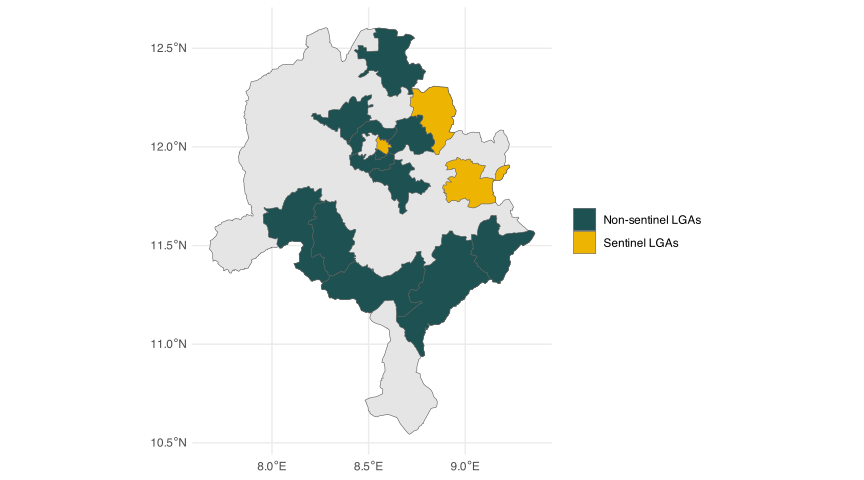
The Kano Zero-Dose Baseline Study aims to establish a baseline estimate of vaccination coverage and zero-dose prevalence in selected LGAs of Kano State (Figure 2.1), where low immunization coverage remains a serious public health challenge.
To assess the impact of upcoming interventions, Kano State Ministry of Health and GF identified three sentinel LGAs—Gaya, Nassarawa, and Gabasawa—as focus areas where Clinton Health Access Initiative (CHAI) will roll out targeted strategies to reduce the number of zero-dose children (shown in yellow in Figure 2.1). The study has monitored these LGAs closely, as reflected in the survey design (Section 3.2), to provide reliable baseline vaccination data and support comparisons during and after CHAI’s interventions.
As a control group, the study also includes twelve non-sentinel LGAs, chosen to represent areas not currently covered by partner interventions (shown in green in Figure 2.1). These include several high-burden LGAs: Bebeji, Dambatta, Dawakin Kudu, Dawakin Tofa, Gezawa, Kiru, Kumbotso, Sumaila, Takai, Tarauni, Tudun Wada, and Ungogo.
Together, the non-sentinel LGAs form a combined control group against which immunization trends in the sentinel LGAs can be assessed before and after interventions. Their inclusion will allow researchers to isolate the causal effect of the planned interventions from underlying trends in vaccine uptake across Kano State.